How to Improve Surfing Skills: 15 Practical Tips to Become a Better Surfer
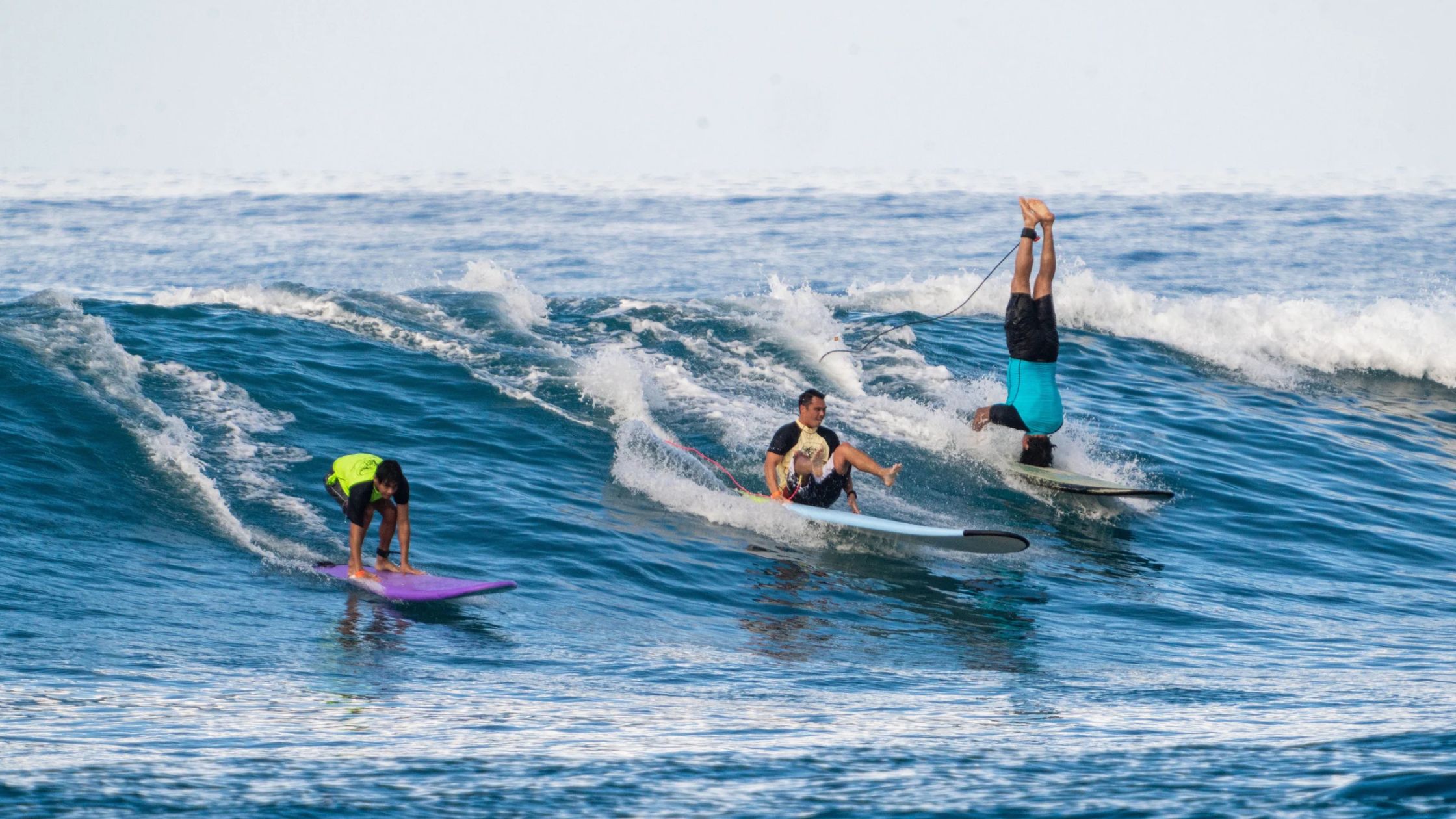
Surfing looks effortless when you watch experienced surfers glide along a wave, make powerful turns and paddle into the perfect position. But anyone who has tried surfing knows how challenging it can be.
You might struggle to catch waves consistently, lose your balance during takeoff or feel exhausted after only a few minutes of paddling. Even surfers with years of experience can reach a point where their progression seems to stop.
The good news? Improving your surfing skills isn't just about spending more time in the ocean. It's about practicing the right techniques, understanding waves and knowing exactly what to work on.
Whether you're learning to stand up consistently or working toward your first proper bottom turn, small improvements in technique can make a noticeable difference.
In this guide, we'll explore 15 practical ways to improve your surfing skills, common mistakes to avoid and a simple four-week training plan to help you become a more confident surfer.
How to Improve Surfing Skills: The 5 Fundamentals
Before trying advanced maneuvers, focus on the skills that influence almost every wave you ride.
Surfing skillWhy it mattersHow to improvePaddlingHelps you reach waves and catch them efficientlyImprove board position, technique and endurancePop-up techniqueCreates a stable transition from paddling to standingPractice controlled takeoffs and foot placementWave selectionDetermines how many suitable waves you catchObserve wave patterns and breaking sectionsBalance and stanceImproves control and stabilityDevelop an athletic stance and controlled weight shiftsTurning and positioningAllows you to follow the wave and generate speedPractice angled takeoffs, trimming and basic turns
If you're a beginner, start with paddling, pop-ups and small-wave positioning.
If you're already catching green waves consistently, focus more on reading the wave, maintaining speed and connecting turns.
1. Improve Your Paddling Technique
Paddling is one of the most important skills in surfing, yet it's often overlooked.
You spend much more time paddling, waiting and repositioning than actually standing on your surfboard.
Poor paddling technique makes it harder to catch waves and wastes energy before the best opportunities arrive.
How to paddle more efficiently
Start by positioning your body correctly on the surfboard.
Lie near the center of the board, adjusting forward or backward to achieve the correct trim.
Keep the nose slightly above the water without lifting it excessively.
Raise your chest enough to paddle comfortably, without straining your lower back.
Reach forward and use smooth, controlled strokes.
Keep your arms reasonably close to the rails.
Avoid unnecessary side-to-side movement.
Your board should glide smoothly rather than pushing excessive water or rocking from side to side.
Paddling drill: 5-minute technique practice
In safe, calm water, with supervision appropriate to your ability:
Paddle at a comfortable pace for 60 seconds.
Focus on maintaining a stable body position.
Rest briefly.
Repeat three times, concentrating on consistent strokes.
Finish with several short accelerations, allowing recovery between efforts.
Common mistake: Paddling with your body too far back on the board, causing the nose to lift and creating unnecessary drag.
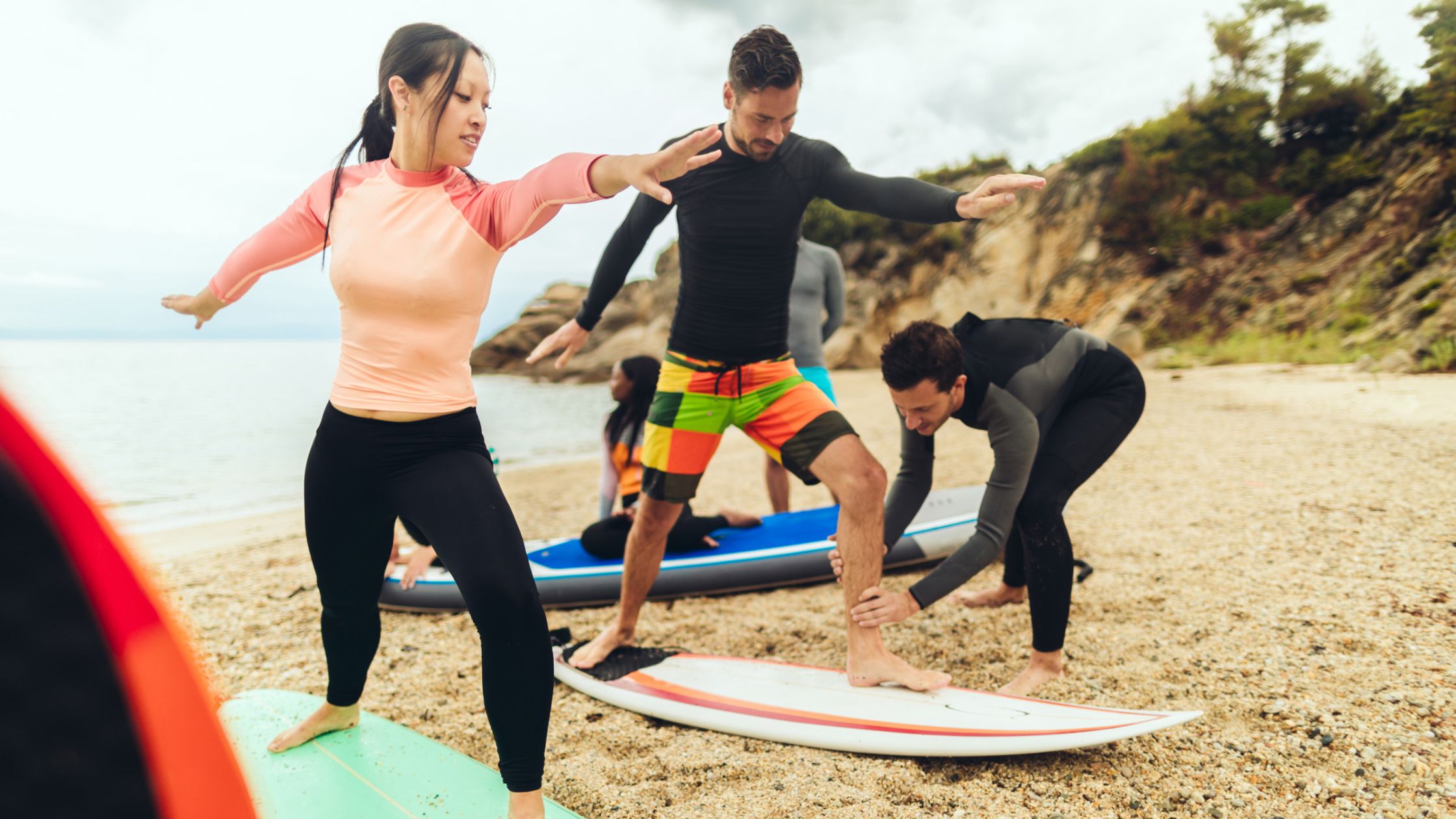
2. Master Your Pop-Up Technique
The pop-up is the transition from lying on your board to standing.
A slow or unstable pop-up can cause you to lose the wave before you've started riding it.
A reliable pop-up should be controlled, efficient and repeatable.
How to improve your pop-up
Lie on your board with your hands positioned beside your lower ribs.
Keep your eyes looking in the direction you intend to travel.
Press through your hands while creating space beneath your torso.
Bring your feet underneath your body in a controlled movement.
Land with your feet positioned appropriately for your board.
Keep your knees bent and your center of gravity low.
Avoid standing completely upright immediately after takeoff.
A compact surfing stance helps you maintain balance and respond to the wave.
Pop-up drill: 10 controlled repetitions
Practice on a stable surface or a surfboard placed securely on soft ground.
Perform 10 controlled pop-ups, focusing on foot position and maintaining balance.
Rest as needed and repeat for two or three sets.
Quality matters more than speed. Avoid rushing through movements with poor technique.
Pro tip: Film your pop-up from the side. Video can reveal whether your feet land in the correct position and whether you're looking down instead of forward.
3. Choose the Right Surfboard for Your Ability
One of the biggest mistakes improving surfers make is switching to a smaller board too early.
Shortboards look exciting, but they generally require more precise paddling, positioning and technique.
A board with insufficient volume can significantly reduce the number of waves you catch.
And fewer waves usually mean fewer opportunities to practice.
What board should you use?
Complete beginners: A stable foam surfboard with generous length, width and volume is usually a good starting point.
Improving beginners: A suitable funboard or mini-mal may provide a balance between stability and maneuverability.
Intermediate surfers: Board selection depends on weight, wave type, paddling ability and preferred surfing style.
There's no universal surfboard volume or length that works for everyone.
The right board should help you catch enough waves to practice the skills you're developing.
Remember: Riding more waves on a forgiving board can be more valuable than struggling on an advanced board that looks impressive.
4. Learn How to Read Waves
If you want to know how to get better at surfing, spend more time understanding the ocean.
Experienced surfers don't randomly paddle toward every wave.
They observe how waves form, where they break and which sections offer the best opportunity for a ride.
What should you look for?
The peak: The area where the wave begins to break.
The shoulder: The unbroken section extending away from the breaking peak.
Closeouts: Waves that break across most or all of their length at once, leaving little opportunity to ride along an open face.
Wave sets: Groups of waves that arrive with intervals between them.
Channels: Areas that may provide easier access to the lineup, although some can contain dangerous currents.
Wave-reading drill: 10 minutes of observation
Before entering the ocean:
Watch the waves from a safe position on the beach.
Identify the most consistent breaking peaks.
Observe whether waves tend to break left, right or close out.
Look for changes in wave shape and size.
Watch where experienced surfers position themselves.
Try predicting which waves will offer the longest ride.
Over time, this observation can help improve both your positioning and wave selection.
5. Improve Your Wave Positioning
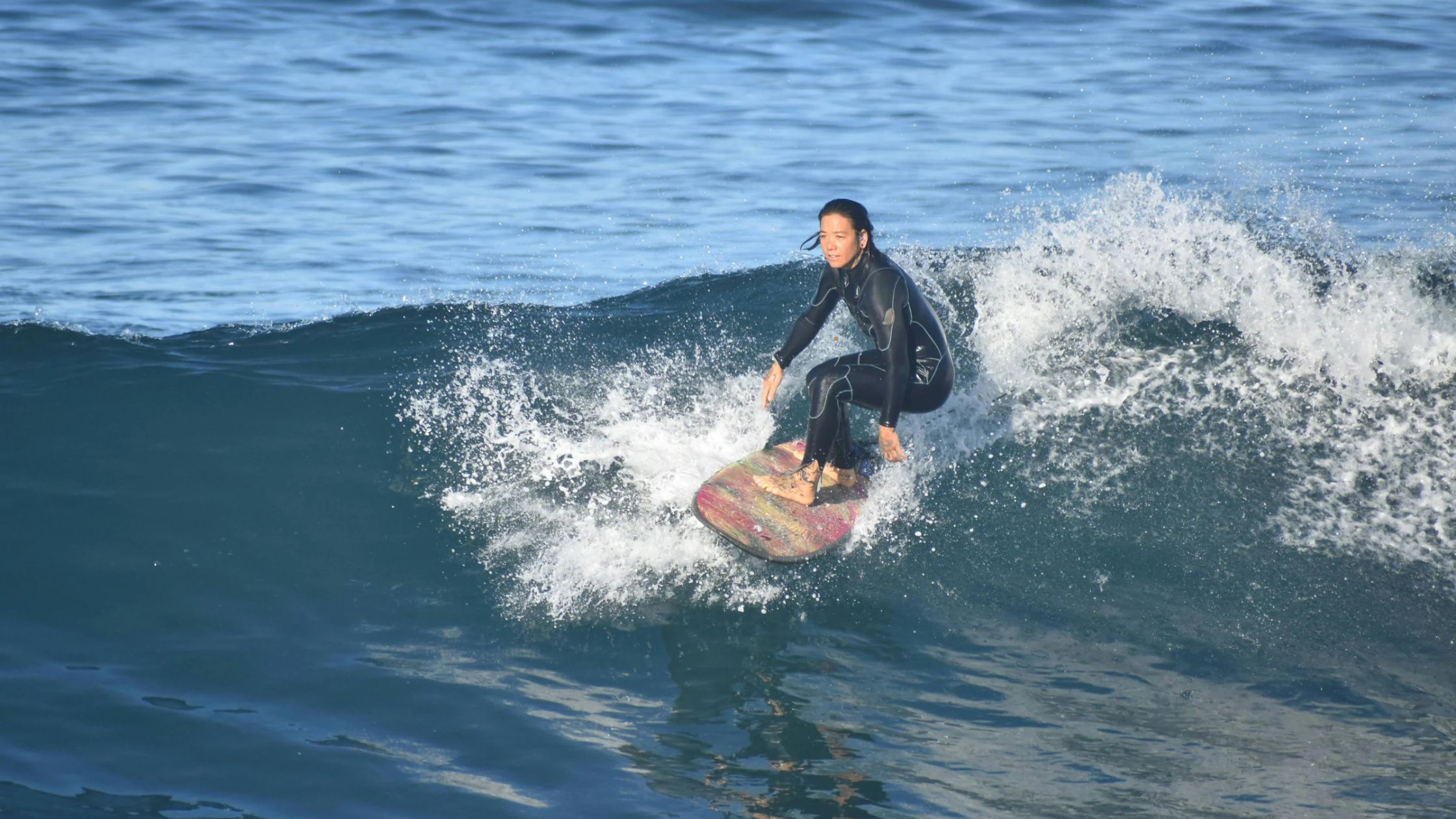
Sometimes the reason you're missing waves isn't your paddling ability.
You're simply sitting in the wrong position.
If you're too far toward shore, waves may break before you can catch them.
If you're too far outside, the wave may not be steep enough to carry you.
How to find a better takeoff position
Study where the wave begins breaking and where successful surfers are catching it.
Use landmarks on shore to help maintain your position, and account for currents that may move you along the lineup.
Your ideal takeoff position depends on the wave, your board and your experience.
For beginners, choose smaller, forgiving waves with a clear path.
Important: Never position yourself directly in another surfer's path or paddle for a wave when someone already has priority.
6. Practice Angled Takeoffs
Many beginners learn by catching broken whitewater and riding straight toward the beach.
That is useful for developing balance.
However, if you want to ride longer unbroken waves, you'll eventually need to learn how to take off at an angle.
How to practice angled takeoffs
Instead of pointing your surfboard directly toward shore, position it slightly in the direction of the open wave face when appropriate.
As you begin catching the wave, keep your eyes focused along the section you want to ride.
Stand up in a balanced position and allow the board to travel across the wave rather than immediately toward the beach.
Start with small, forgiving green waves.
Avoid steep or crowded takeoff zones until you have better control.
Training goal: Catch several small waves while maintaining a controlled direction along the open face.
7. Improve Your Surfing Stance and Balance
Your stance influences almost every movement you make on a surfboard.
Poor positioning can make a stable board feel unpredictable.
What does a good surfing stance look like?
Feet positioned appropriately along the board's centerline.
Knees comfortably bent.
Weight distributed in a balanced, adaptable way.
Head and eyes looking toward your intended direction.
Upper body relaxed enough to move naturally.
Arms positioned to assist balance without excessive swinging.
Avoid bending excessively at your waist while keeping your legs straight.
Instead, lower your center of gravity through your knees, hips and ankles.
Balance drill: Surf stance holds
On stable ground:
Stand in your surfing stance.
Bend your knees into a comfortable athletic position.
Maintain balance for 20–30 seconds.
Make small, controlled weight shifts.
Repeat several times.
You can also practice rotating your head and shoulders while keeping your stance stable.
For extra feedback, use a mirror or record your movements.
8. Learn How to Generate Speed on a Wave
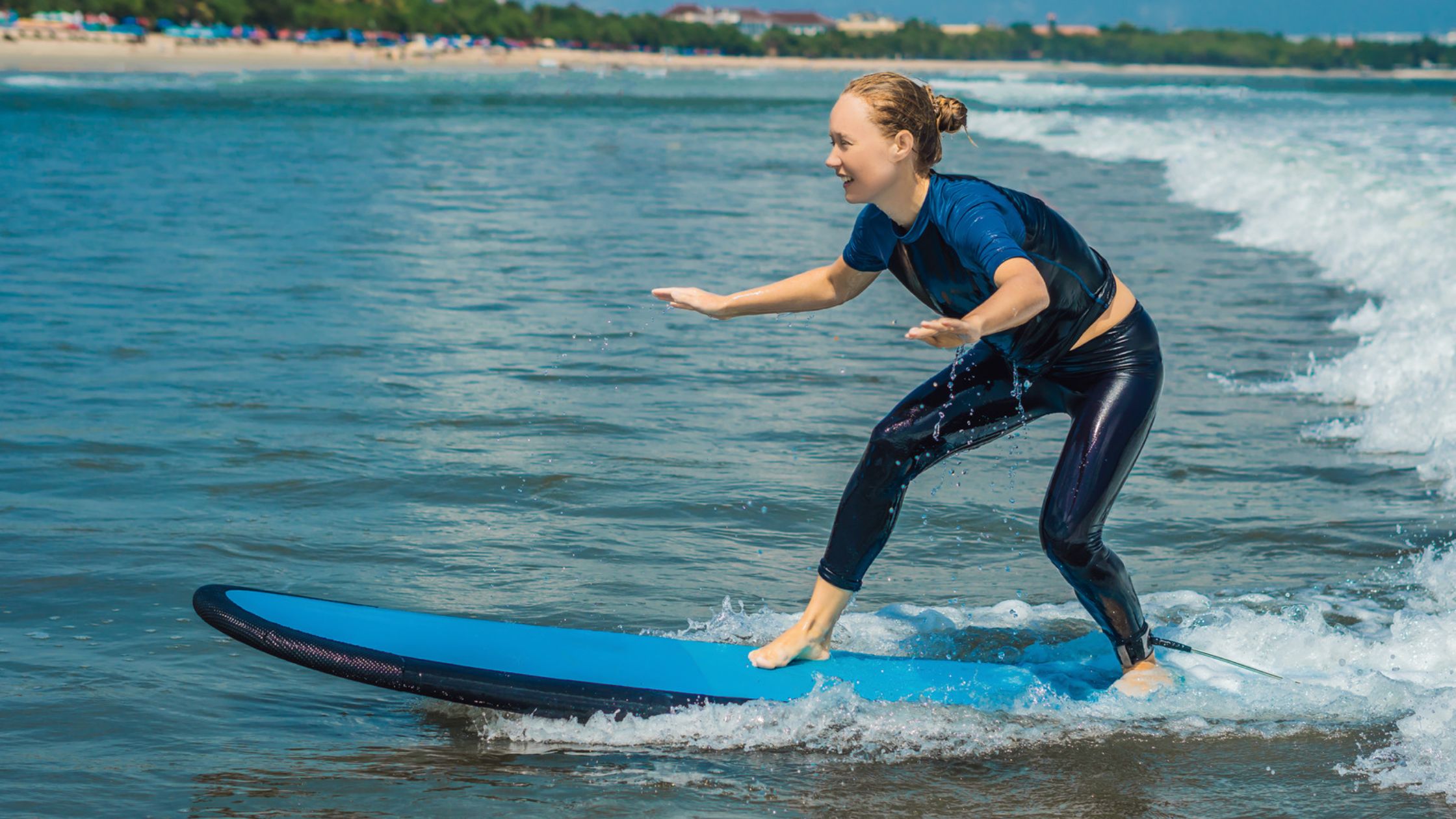
Once you can catch green waves, the next challenge is maintaining speed.
Many improving surfers ride down the wave, lose momentum and eventually get caught by the breaking section.
Speed comes from using the wave's shape, choosing the right line and making controlled movements.
Start with trimming
Trimming means adjusting your position and direction to maintain speed along the wave.
Look ahead toward the open section and avoid unnecessarily traveling onto flat water.
Progress to compression and extension
More advanced surfers use coordinated compression and extension to gain speed across the wave face.
This involves changing body position and directing the board through suitable sections of the wave.
However, aggressive pumping before you've developed basic control can make your surfing worse.
Focus first on: Reading the wave, choosing the correct line and maintaining smooth movement.
9. Develop Your Bottom Turn
The bottom turn is one of the most important maneuvers in surfing.
It's the turn that redirects your board after dropping down the wave face.
A controlled bottom turn allows you to move back toward the wave's most useful sections and sets up more advanced maneuvers.
How to practice your first bottom turn
Catch a manageable green wave.
Maintain a stable, low stance.
Look toward the section where you want to travel.
Begin turning by coordinating your head, shoulders, hips and lower body.
Apply controlled pressure through the board's rail.
Follow the turn without forcing an abrupt movement.
Start on forgiving waves with enough room to maneuver.
A coach can help identify whether you're turning too early, leaning incorrectly or losing speed through poor positioning.
Remember: Mastering a basic bottom turn is more useful than attempting advanced tricks before you can consistently control your board.
10. Improve Surfing Fitness Outside the Water
Surfing requires a combination of aerobic endurance, short bursts of paddling effort, strength, mobility and coordination.
However, general gym fitness doesn't automatically translate into better surfing technique.
Your training should support the physical demands of surfing while leaving enough time and energy for actual practice.
Useful exercises for surfers
Swimming: Helps develop general conditioning and comfort in the water, although it doesn't perfectly replicate surfboard paddling.
Rows and pulling exercises: Strengthen muscles used in pulling movements and upper-body stabilization.
Push-ups: Support upper-body strength relevant to pop-up movements.
Squats and lunges: Develop lower-body strength and control.
Planks and anti-rotation exercises: Improve trunk strength and stability.
Mobility work: Can help maintain comfortable movement through the shoulders, hips and upper back.
Sample 20-minute surf fitness workout
Complete two or three controlled rounds:
ExerciseRepetitionsBodyweight squats12Push-ups8–12Reverse lunges8 per legResistance-band rows12Plank30 secondsControlled pop-ups5
Rest between exercises and adjust the repetitions to your ability.
Training tip: Good movement quality is more important than completing repetitions quickly. Exercise does not replace actual surfing, and additional fatigue can negatively affect your next surf session.
11. Surf More Consistently, Not Just Longer
Surfing for three hours once a month isn't necessarily better than taking several shorter, focused sessions.
Consistency gives you repeated opportunities to practice and reinforce technique.
If your schedule allows, aim for regular sessions in conditions appropriate to your ability.
Use one objective per session
Instead of entering the water with a vague goal of getting better, choose one specific skill.
For example:
Session 1: Improve paddling efficiency.
Session 2: Practice controlled pop-ups.
Session 3: Focus on wave positioning.
Session 4: Catch more unbroken waves.
Session 5: Improve angled takeoffs.
This makes it easier to identify progress and understand what still needs work.
Don't force sessions when conditions are unsafe or when you're too fatigued to surf effectively.
12. Record Your Surfing and Analyze Your Technique
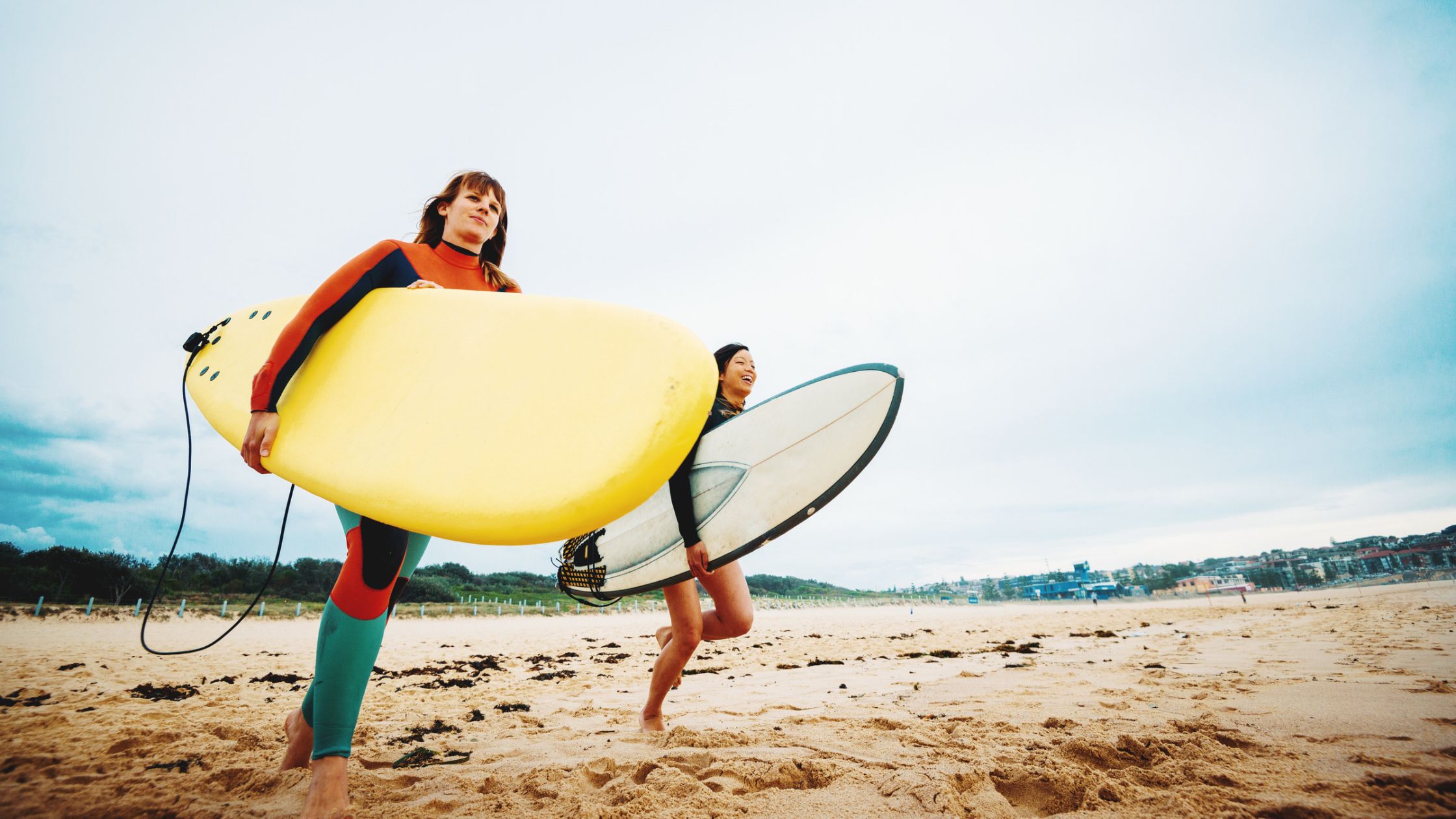
Video feedback can reveal mistakes that are almost impossible to identify while you're riding a wave.
A movement that feels smooth may look completely different on camera.
What should you look for?
During paddling: Is your board properly positioned? Are your strokes effective?
During takeoff: Do you stand smoothly? Are your feet placed correctly?
During the ride: Are you looking in the direction you want to go? Are your knees bent?
During turns: Are you using the wave effectively or making unnecessary movements?
Film yourself from a safe shore location when possible, or work with a surf coach who offers video feedback.
Create a simple surfing progress log
After each session, record:
Approximate number of waves caught.
Number of controlled takeoffs.
Conditions and surfboard used.
One technique that improved.
One technique to work on next time.
These observations can help reveal progress over multiple sessions.
Don't obsess over numerical scores. Wave conditions vary, so catching fewer waves on a challenging day doesn't automatically mean you've become worse.
13. Learn Surf Etiquette and Ocean Safety
Better surfing isn't only about technical ability.
It's also about making good decisions in the water.
A confident surfer should understand wave priority, maintain control of their board and avoid creating risks for others.
Essential surfing etiquette
Respect wave priority. In general, the surfer closest to the breaking section has priority, although situations vary depending on the break.
Don't drop in. Avoid taking off in front of someone already riding a wave.
Keep control of your board. Never deliberately release your board toward other people.
Paddle safely. Avoid obstructing surfers riding waves.
Know your limits. Don't paddle into waves beyond your experience simply because other people are surfing them.
Learn to recognize unsafe conditions
Strong currents, large shorebreaks, shallow reef and rapidly changing weather can create serious hazards.
Before surfing, check the local conditions and seek advice when necessary.
If you're caught in a rip current, remain calm, avoid trying to swim directly against it and signal for help when needed.
Developing good judgment is part of becoming a better surfer.
14. Surf Different Waves as Your Skills Improve
Different waves help develop different aspects of your surfing.
However, progression should be gradual.
Beach breaks
Often useful for practicing basic surfing skills, particularly when waves are smaller and the bottom is sandy.
Point breaks
Can offer longer rides that allow improving surfers to practice trimming and turns.
Reef breaks
May offer consistent wave shapes but can introduce significant hazards, including shallow coral, strong currents and more challenging takeoffs.
For beginners, appropriate beach breaks are generally a more forgiving starting point.
Once you're comfortable catching and riding unbroken waves, you can gradually explore more demanding conditions with experienced local guidance.
Where to improve your surfing in Bali
Bali offers various surf environments suited to different experience levels.
Kuta and Legian: Often suitable for beginner progression on small days.
Batu Bolong, Canggu: Popular with longboarders and improving surfers, although crowds and a mixed seabed require caution.
Dreamland: Can offer opportunities for improving surfers in suitable small conditions, but stronger surf and shorebreak can be challenging.
Balangan: A reef break generally more appropriate for intermediate to advanced surfers.
Uluwatu and Bingin: Famous advanced reef breaks that should not be treated as beginner training locations.
Explore Bali's surf beaches on GetSurf to discover locations and learn more about their characteristics.
15. Take Surf Lessons with an Experienced Local Instructor
One of the most effective ways to improve your surfing is to receive targeted feedback from an experienced instructor.
It's possible to develop habits that feel natural but limit your progression.
A coach can identify those habits and suggest specific corrections.
What can a surf instructor help you improve?
Depending on your level, coaching may focus on:
Paddling and takeoff positioning.
More consistent pop-ups.
Wave selection and ocean awareness.
Surfing stance and foot placement.
Catching unbroken waves.
Speed generation and trimming.
Basic turning techniques.
Surfing safely in unfamiliar conditions.
Why private surf coaching can be valuable
Private coaching can provide more individual attention than a larger group lesson.
Your instructor can observe your movements, identify technical weaknesses and adjust the lesson to your current ability.
This can be particularly useful when you're trying to overcome a specific plateau.
With GetSurf, you can explore surf destinations and connect with independent local instructors who can help you work toward your surfing goals.
A 4-Week Plan to Improve Your Surfing Skills
If you're unsure how to organize your practice, use this four-week progression framework.
It's designed primarily for beginners and improving surfers who already have basic water confidence.
The schedule assumes access to suitable conditions, adequate recovery and instruction when needed. Adjust the number of sessions to your fitness and experience.
WeekFocusPractice objectivesWeek 1FundamentalsPaddling, stance and consistent pop-upsWeek 2Wave selectionReading waves, positioning and catching suitable wavesWeek 3Green-wave progressionAngled takeoffs, trimming and maintaining directionWeek 4Better controlBasic turns, video feedback and technique refinement
Week 1: Build Better Fundamentals
Focus on your board position, paddling efficiency and pop-up.
Practice controlled takeoffs on land and apply the same movements in suitable small waves.
Goal: Become more consistent at catching manageable waves and standing in a balanced position.
Week 2: Improve Your Wave Selection
Spend time observing the ocean before entering.
Practice identifying suitable peaks and positioning yourself to catch waves more efficiently.
Goal: Make better decisions about which waves to paddle for.
Week 3: Progress to Unbroken Waves
If you're ready, begin practicing angled takeoffs on small, forgiving green waves.
Focus on your direction and maintaining a controlled line across the wave.
Goal: Start riding along the open face rather than traveling directly toward shore.
Week 4: Improve Your Control
Use video feedback or coaching to identify areas for improvement.
Practice maintaining speed and introducing gentle turns.
Goal: Ride more confidently while making deliberate, controlled movements.
Four weeks won't automatically turn you into an intermediate surfer. Treat this plan as a flexible progression framework rather than a guaranteed timeline.
Frequently Asked Questions About Improving Surfing Skills
How can I improve my surfing skills quickly?
Focus on the fundamentals that affect every wave: paddling, takeoff positioning, pop-up technique, stance and wave selection. Regular, purposeful sessions and feedback from an experienced instructor can help accelerate improvement.
How long does it take to become good at surfing?
There is no fixed timeline. Progress depends on your practice frequency, athletic background, wave conditions, instruction and goals. Standing on a surfboard is an early milestone, while becoming a competent independent surfer requires considerably more experience.
Can I improve my surfing without going into the ocean?
Yes, to a degree. You can improve strength, mobility, general fitness and pop-up mechanics on land. However, wave-reading, paddling into moving waves and actual board control require experience in the water.
What exercises help improve surfing?
Useful exercises include swimming, rows, push-ups, squats, lunges, planks and controlled pop-up practice. A balanced strength and mobility program can support your surfing, but it cannot replace time on appropriate waves.
How often should I surf to improve?
Regular practice generally supports progression better than infrequent sessions. The ideal frequency depends on conditions, fitness and recovery. Two or three purposeful sessions per week can be a useful schedule for some recreational surfers, but consistency and technique quality matter more than a fixed number.
Why am I not getting better at surfing?
Common reasons include poor wave selection, inconsistent practice, unsuitable equipment, ineffective paddling and repeating the same technical mistakes. Video feedback or a lesson focused on your weaknesses can help identify the main issue.
Can surf lessons help intermediate surfers?
Absolutely. Surf lessons aren't only for beginners. Intermediate coaching can help with angled takeoffs, trimming, speed generation, turns, wave positioning and more advanced technique.
Is Bali a good place to improve surfing skills?
Yes. Bali has a wide variety of wave types and surf instructors. The key is choosing a location appropriate for your experience and the day's conditions. Beginners should avoid advanced reef breaks and prioritize suitable training beaches.
Final Thoughts: Improve Your Surfing One Wave at a Time
Becoming a better surfer doesn't happen overnight.
Progress comes from repeated practice, better decision-making and learning to understand how your board interacts with the ocean.
Start by improving your paddling, pop-up and stance. Then focus on wave selection, positioning and riding unbroken waves.
As your confidence grows, develop better speed control and turning techniques.
Most importantly, practice with a purpose.
You don't need to catch the biggest wave or ride the shortest board to become a better surfer. You need to build the skills that allow you to surf confidently, consistently and safely.
Ready to Take Your Surfing to the Next Level?
Whether you're struggling with your first pop-up or want to improve your turns, personalized surf coaching can help you identify what to work on.
GetSurf connects travelers with independent local surf instructors in Bali.
Explore surf spots in Bali, browse local surf instructors and send a free surf lesson request to start improving your skills.